
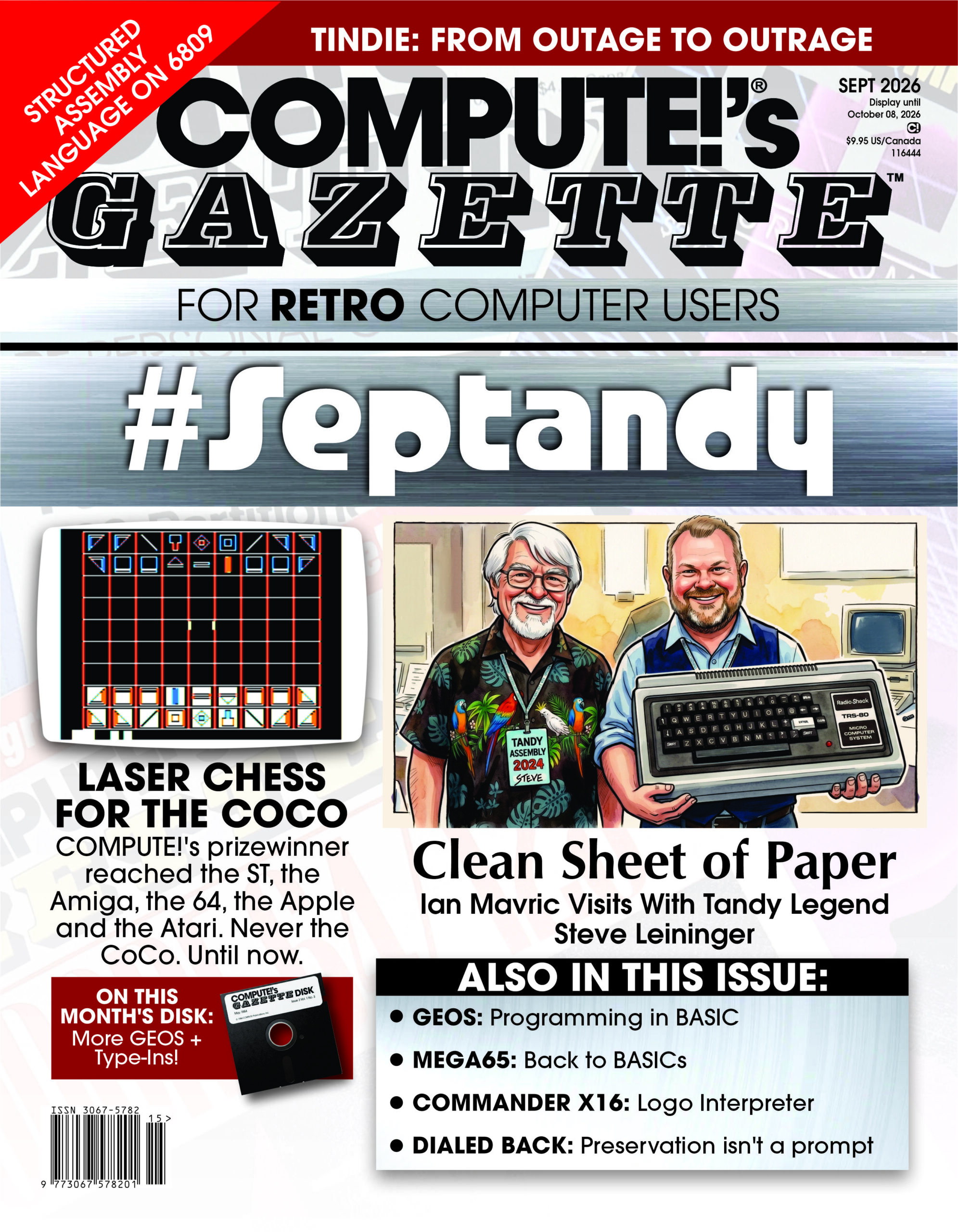
#SepTandy: The 8-Bit Networking Issue
116 pages. The biggest issue we’ve ever printed.
We didn’t plan it that way. The articles came in, we read them, and every time we sat down to decide what could wait until October, we came up empty. So we added pages instead.
September is our Tandy issue. The Radio Shack machines put computers on a shelf in a store where ordinary people already shopped, in every town in the country — and a lot of us got our start on a Model I or a CoCo because it was the machine we could actually walk up to and touch. This issue gives that heritage the same care we give the Commodore and Atari material.
Clean Sheet of Paper — a visit with Steve Leininger
Ian Mavric sits down with the engineer who designed the TRS-80 Model I. Leininger takes us from repairing guitar amplifiers in an Indiana music store, to writing a letter to Intel asking for a free manual and getting seven, to the Homebrew Computer Club, to the moment Radio Shack’s president said the machine would not ship as a kit. He talks candidly about the Expansion Interface noise problems, the lowercase decision, what he’d change, and what it was like to build a computer nobody had asked for. Nearly fifty years on, it’s the most complete account of the Model I’s origins we’ve published.
Laser Chess finally comes to the Color Computer
In 1987, COMPUTE! ran a programming competition and Mike Duppong won it with Laser Chess. Within months the magazine had printed ports for the ST, the Amiga, the Commodore 64, the Apple II and the Atari 8-bits. The CoCo never got one. There was no good reason for that — it’s a turn-based board game with no sprites, no scrolling and no sound to speak of. It simply wasn’t written, and then it was too late.
It’s written now. This issue carries two complete versions, a hi-res graphics build and a text build, both ready to type in, plus a full guide to the pieces, the mirrors, the hypercube and the beam.
Also inside
- From Outage to Outrage — Tindie’s payment collapse, told by the sellers whose small businesses were upended by it, with responses from the marketplace itself.
- Channel Surfing the 8-Bit Era — five of the biggest names in retro-computing YouTube (LGR, Tech Tangents, Necroware, Bits und Bolts, The Silicon Siren) answer the same questions. What surprised us most wasn’t where they disagreed — it was how often they didn’t.
- The Business Machine That Learned to Play — John Swiderski brings a dead TRS-80 Model 16 back to life over an 8-inch disk drive and then teaches it to run a falling-block game built entirely from text, in Model II BASIC and again under CP/M.
- Structured Assembly Language — Keith Frechette on 6809 SAL for the CoCo 3: structured control flow, procedures and local variables, without giving up the assembler.
- The 640K Club — from the 8088 to the 486, with a look at how good Tandy support in the emulation and expansion tooling has quietly gotten.
- Tandy Land — Ian Mavric on Tandy Assembly’s new home, the #Septandy video festival, TRS8Bit, and new hardware for the Model 4.
- Commander X16 Logo — John Paul Gignac’s full Logo interpreter for the X16. Turtle graphics, procedures, recursion, the works.
- Columns: COMPUTE!’s Commodore Corner with Peri Fractic • Programming GEOS in BASIC with Bruce Thomas • Ask Ray with Ray Carlsen on power supplies that kill • Dialed Back: Preservation Isn’t a Prompt • INSIGHT: Atari • FujiNet Report: writing FujiNet programs for the Intellivision • MEGA65 Digest • The Gazette Wire • Lost & Found • Amiga reviews.
Introducing MLX32
For more than a decade, MLX was how machine language reached Commodore owners, and a generation learned to recognize a bad checksum by the sound of the beep. MLX32 replaces it. It prints the same programs in about a third of the space, catches more of the mistakes readers actually make, and can rebuild a line you can’t read at all — a smudge, a crease, a bad scan. One file runs on both the Commodore 64 and the Commander X16.
Type-ins this month
Laser Chess for the CoCo (graphics and text versions) • BOWLERSD.BAS, Jerry White’s bowling league database for the Atari • the Commander X16 Logo interpreter in MLX32 format • Back to BASIC Part 5, where we build a word-guessing game and take strings apart a character at a time • and two new Micro Missions from The Evil Professor.
The Tandy Rolodex
A new recurring back page: ten shops still making new parts for machines Radio Shack stopped selling a generation ago. Nobody paid us for the space and we didn’t ask. We run it as a community service, and it will be in every issue from here on.
What you get
A 116-page full-color print magazine, professionally printed and mailed, plus the digital edition. The companion disk carries more GEOS material and every type-in from this issue, so you can load the programs instead of typing them — though we’d never talk you out of typing them.