
By Dave & Casey Gardner — originally published in COMPUTE!’s Gazette Issue 2, August 1983
“The Viper” is a fast-action game with 27 difficulty levels for the unexpanded VIC-20. A translated version for the Commodore 64 has 60 difficulty levels. A joystick is required.
The Viper is a fast, furious, hungry snake. It races about, devouring its favorite food — asterisks! And the more it eats, the bigger it gets. Since snakes have a hard time growing wider, the Viper simply gets longer. Since the Viper has such sharp, venomous teeth, it must not in its haste accidentally run into its own lengthening body. To make things especially interesting, the Viper must maneuver through a maze with electric walls. One false move means certain doom.
With a joystick and a VIC-20 or Commodore 64, you can experience the perils of the Viper. The program is easy to set up and play. Just follow the screen instructions. Maneuver the Viper with a joystick plugged into port one. Don’t leave the Play button on the cassette recorder pressed after the program is loaded, or the joystick may not respond properly. Sometimes pressing RUN/STOP and RESTORE before playing helps too, especially for disk users.
You can choose from various difficulty levels to control the Viper’s speed — nine levels on the VIC and 20 levels on the 64. You also select one of three courses — no maze, the easy maze, or the hard maze. Your score is the number of those delicious asterisks eaten multiplied by the skill level you selected, so the harder the game, the more possible points. You get twice as many points for the easy maze, and five times as many for the hard maze.
Available On Tape
If you don’t want to type this program, the authors will save it on tape for you (VIC version only). Send a blank cassette, self-addressed stamped mailer, and $3 to:
Dave Gardner
2342 Barnes Road
Walworth, NY 14568
A Word To Programmers
The VIC version uses a clever joystick routine published in the October 1982 COMPUTE! Magazine. Since the routine is written in machine language, it speeds up the already fast response of the VIC-20. The Commodore 64, however, is “burdened” with more memory and graphics power, which ironically tend to make games run somewhat more slowly. To compensate, the entire main loop of the program was translated into machine language for the 64. The resulting speed was so fast that delay loops had to be inserted just to slow it down to a barely playable level. If you’re brave enough, try level 20 — you’ll never be able to play it. If anyone can score any points on level 20 with the hard maze, it would be truly miraculous.
Also, the 64 version was changed so you don’t have to use the keyboard.
Father-Son Programming
John Blackford, Assistant Features Editor
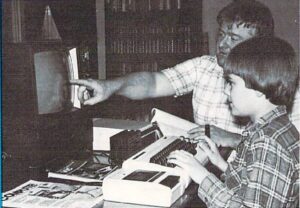
“The Viper” was created by a father-son programming team, Dave Gardner and his son Casey, age 11. They’ve had their VIC-20 only a little more than a year, but they are planning to write even more programs together, using any proceeds to pay for new computer equipment. Their earnings for The Viper, for example, will help purchase a disk drive.
Gardner learned BASIC on the VIC and decided to try his hand at game programming to hone his skills. The idea of making a snake that grows longer as it eats occurred to him after watching a similar game on an Apple computer. Gardner did the actual programming, while Casey dreamed up new ideas and helped with the design.
Gardner didn’t plan how he was going to implement the game. “I just sat down at the keyboard and started working on it,” he says. “First I got the screen set up, then defined the snake.” Next came the snake’s movement and the interaction with the asterisks it gobbles up. After Gardner had refined the movement of the Viper, he added skill levels by making the snake move faster in each of nine stages. Then he worked out scoring routines that award more points in the higher levels.
As the game progressed, Casey and his father would talk about it and try to improve the concept. Casey came up with the notion of having a maze for the snake to move through and that became his special project. After his father showed him how to use graph paper to represent the computer’s screen, Casey began to draw various possible mazes. “He did about eight designs,” says Gardner. “We talked over what would be the most playable — and the most achievable with the computer.” Then, they chose the version that seemed best.
Once they had the basic game, they decided to increase the number of skill levels by offering two mazes, one easy, the other hard. Including the option of no maze at all, there are a total of 27 skill levels.
The whole process of creating the game — including writing the program description — took only about two weeks, working an hour or two on weekdays and six or more hours each day on the weekends.
Creating the game was intense, but that has only whetted their appetite. Their current project is an adventure game with quality graphics. Casey has shown particular aptitude for the visual side. “He tends more toward the artistic aspects,” says Gardner. Casey, who likes to sit at the computer and work out new character sets, has already designed the title page for the new game.
They haven’t decided what they’ll do after that, but they enjoy working together and hope to produce many more games as a team.